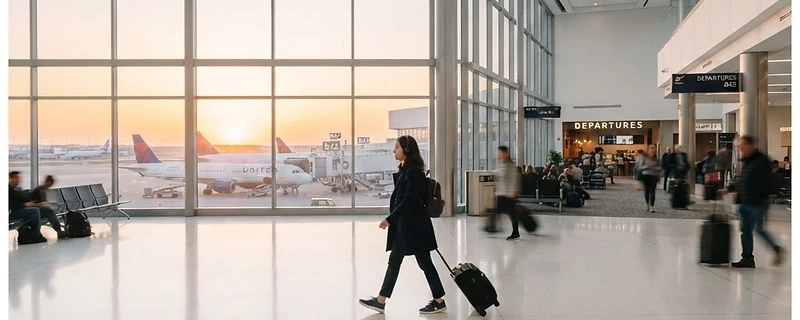
The Compass of Transit: How to Navigate Busy International Airports with Confidence
Transform the chaos of major international hubs into a seamless start to your journey with these essential, calm, and practical navigation strategies.
The Architecture of Departure
Stepping into a major international hub like London Heathrow, Singapore Changi, or Tokyo Narita for the first time can feel like being caught in an accelerated film of modern life. The sheer scale—the endless corridors of glass and steel, the rhythmic announcements in a dozen languages, the pressing urgency of travelers—is designed to be efficient, but for the uninitiated, it often feels like a puzzle. Navigation is not merely about finding your gate; it is about maintaining your equilibrium while moving through a high-stakes ecosystem. The secret to mastering the hub is realizing that these spaces are designed with a logical flow. Once you understand that flow, you stop being a passenger in chaos and start being a pilot of your own itinerary.
Before you even set foot in the terminal, your journey begins with the architecture of your preparation. Most travelers make the mistake of waiting until they arrive at the curb to check their flight status. Instead, commit to a 'three-hour rule' for international departures. If you are flying on a major carrier like Emirates, Singapore Airlines, or United, use their official mobile app to track terminal changes or gate assignments in real-time. These apps often provide interactive terminal maps that are significantly more accurate than the static signs scattered throughout the concourse.
Mapping the Flow of the Terminal
Once inside, your priority is to deconstruct the terminal’s geography. Most international hubs operate on a modular design, separating arrivals and departures by level. If you are connecting between flights, pay close attention to signs labeled 'Transfer' or 'Transit.' Never follow the exit signs if your ticket includes a connection, even if you see baggage claim indicators. If your bags are checked through to your final destination, your only goal is to find your next gate, usually following signs for 'Flight Connections.'
Navigating security is the moment most travelers experience the highest friction. To ensure a smooth process, consider these tactical adjustments:
- Wear slip-on footwear and avoid excessive jewelry or metal accessories that trigger sensors.
- Keep your electronics, such as laptops and tablets, in a dedicated sleeve near the top of your bag for quick retrieval.
- Fill a reusable water bottle only after you have cleared the security checkpoint.
- Utilize digital boarding passes stored in your Apple Wallet or Google Pay to avoid fumbling with paper documents.
- Look for the far-left or far-right security lanes, as these are often less crowded than the central lanes.
Finding Stillness in the Interim
What do you do when you have four hours to kill in an unfamiliar city? The temptation is to find the nearest gate and sit on the floor, but the most refined travelers treat the terminal like a city of its own. Look for quiet zones—these are often tucked away on upper levels near library or meditation rooms, which are becoming standard in modern hubs like Doha’s Hamad International or Incheon.
If you find yourself in a city with excellent transit, such as Hong Kong or Zurich, and you have a layover exceeding six hours, do not fear leaving the airport. Many of these hubs offer 'Airside' luggage storage services. You can drop your carry-on, take the express train into the city for a bowl of authentic local noodles, and return with plenty of time to clear security again. For instance, in Tokyo, the Narita Express can whisk you into the city center in under an hour, allowing you to walk through a quiet temple neighborhood like Yanaka before your long-haul flight.
Remember, the best time to visit or traverse these hubs is during mid-week, specifically Tuesdays and Wednesdays, when foot traffic is notably lower. If you are hunting for cheap flights to these destinations, use search tools that allow you to toggle 'nearby airports' to see if a slightly smaller, more manageable hub might offer a more relaxed entry point into your destination country. How to redeem miles effectively often involves looking for these hub-and-spoke connections, which can save you significant costs on international tickets.
The Final Approach
As you approach your gate, resist the urge to queue immediately upon boarding announcement. Unless you have specific overhead bin concerns, staying seated and allowing the initial crowd to dissipate preserves your personal space and energy. By the time you board, you will be the last one to sit, minimizing the time spent in the cramped confines of a parked aircraft.
This article is general information and not legal, financial, or medical advice. Always check the latest visa requirements and health protocols for your transit country, as rules regarding transit visas and vaccination certificates can change rapidly based on your nationality and current global health policies.
Ready to plan less and travel more? See Trippanna Premium →
This article may contain affiliate links. Trippanna earns a commission on bookings made through partner links, at no extra cost to you. All bookings are the responsibility of the third-party provider.