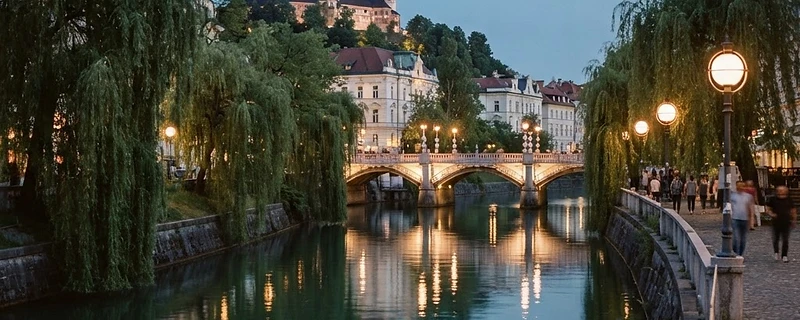
Ljubljana: The Emerald Heart of Europe
Beyond the shadow of its larger neighbors, Slovenia’s capital unfolds as a quiet masterpiece of willow-lined canals, Baroque architecture, and an unwavering commitment to the slow, intentional life.
A City Defined by Stillness
There is a particular light that settles over Ljubljana in the shoulder season. It is not the piercing, aggressive sun of the Mediterranean, but a soft, honeyed glow that catches the weeping willows dipping their branches into the Ljubljanica River. While the rest of Europe often feels like a rush to see and be seen, the Slovenian capital moves with the gentle cadence of a river current. It is a city that feels less like a tourist destination and more like a well-kept secret shared among friends who value silence as much as conversation.
Walking the Triple Bridge—the architectural signature of Jože Plečnik, who essentially designed the city’s modern identity—you realize that Ljubljana is a pedestrian’s sanctuary. Cars are largely banished from the center, replaced by the rhythmic clatter of bicycles and the quiet hum of locals enjoying their morning coffee at outdoor tables. In this city, space is treated as a luxury, and time is treated as a resource to be savored rather than spent.
The Rituals of the Local Market
To understand the pulse of Ljubljana, one must visit the Central Market at dawn. Designed to bridge the space between the Cathedral of St. Nicholas and the river, the market is a testament to the country’s deep agricultural roots. Here, you will find farmers from the nearby Gorenjska region setting out baskets of forest-foraged chanterelles, jars of golden wildflower honey, and cheeses so sharp they linger on the palate for hours.
If you find yourself wandering the stalls, keep an eye out for these seasonal staples:
- Kranjska klobasa: A protected, artisanal Carniolan sausage that serves as the backbone of local comfort food.
- Potica: A traditional rolled pastry filled with walnuts, poppy seeds, or tarragon, best enjoyed with a glass of local white wine.
- Wild Garlic: If visiting in the spring, the scent of fresh ramps fills the air, appearing in everything from pesto to creamy soups.
For lunch, skip the main squares and duck into Gostilna Sokol. It is a place that rejects the modern urge for minimalist decor, opting instead for heavy timber, stained glass, and the smell of slow-roasted meats. It is here that you learn that Slovenian hospitality is not about grand gestures; it is about the warmth of a heavy ceramic bowl and a glass of wine from the nearby Vipava Valley.
Climbing Toward History
No visit is complete without a slow ascent to the Ljubljana Castle. While most visitors take the funicular, I urge you to walk the winding paths that climb through the steep, wooded hillsides. As you rise, the city below shrinks into a patchwork of terracotta roofs and green copper spires. The fortress itself, a sentinel that has watched over the basin for nine centuries, is not a stagnant museum. It is a living space where contemporary art installations frequently clash beautifully with medieval masonry.
As the sun dips behind the Julian Alps, the city takes on a transformative quality. The streetlamps—designed by Plečnik to resemble celestial globes—flicker to life, casting long, dramatic shadows across the cobblestones. There is no nightlife here in the frantic sense; instead, there is the clinking of glasses in wine bars like Dvorni Bar, where the conversation is focused, intimate, and never hurried. In Ljubljana, you are not just checking a box on a map. You are participating in a quiet, enduring tradition of life lived well, at exactly the speed the soul requires.
This article may contain affiliate links. Trippanna earns a commission on bookings made through partner links, at no extra cost to you. All bookings are the responsibility of the third-party provider.